
Showing posts with label Storytelling Project. Show all posts
Showing posts with label Storytelling Project. Show all posts
Sunday, 6 March 2011

Thursday, 3 March 2011
Wednesday, 2 March 2011
Cloverfield (2008)
 |
| Fig. 1 Theatrical Poster |
It's most innovative feature is the use of "previously recorded" footage to give some backstory to a film that purports to have been recorded over the course of about 6 hours in a linear fashion. This is most effective in the very ending of the film, just after the camera has been bombed by the USAF (mercifully cutting short the emotional video-will of the "hero") and it cuts to the previous day, with the hero and his girlfriend enjoying a happy day out at Coney Island (while in the background a mysterious object can just be glimpsed falling into the sea). The director also manages to sneak in proper cinematic shots under the guise of television news reports, these provide some of the clearest early glimpses of the Monster, as well as the "lice" that drop from its body and promptly seek out any human they can get their many teeth into (an idea that may have seemed clever to the script writers, but lost it's impact as a result of having featured in a video game - dan).
 |
| Fig. 2 Film Still |
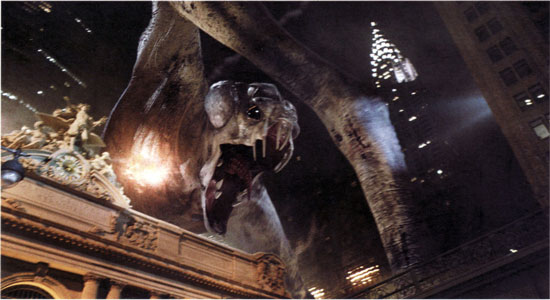
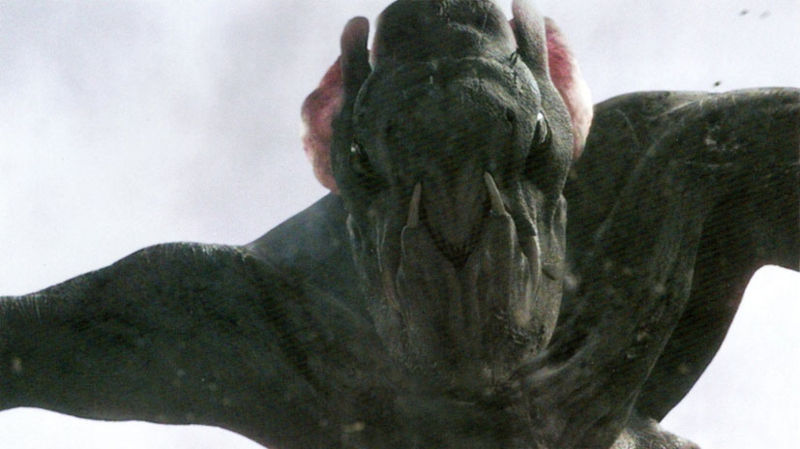
The most effective moments in the film occur early on during the attack, as the camera catches brief, unfocussed glimpses of a huge shape moving amongst distant skyscrapers. These snatched sights provide enough information to give a sense of size and alien-ness, but without tying down the audiences mental images with anything concrete (Ebert, 2008). When the monster is finally revealed in full, it seems almost a let down - the worst horror the audience's imagination can conjure is replaced with the special-effects artists idea of a monster. In some ways, the "lice" are more successful at creating fear in the audience - whilst they are shown in their entirity once or twice, it is never for more than a fraction of a second and only as part of rapidly intercut sequences that don't give the viewer time to fully register their appearance.
 |
| Fig. 3 Film Still |
List of Illustrations
Figure 1. Paramount Pictures (Org) (2008) "Cloverfield" Theatrical Poster [Digital Image] At: http://www.impawards.com/2008/cloverfield_ver2.html (Accessed on 02/03/2011)
Figure 2. Paramount Pictures (Org) (2008) Cloverfield [Film Still] At: http://cloverfield.wikia.com/wiki/Clover (Accessed on 02/03/2011)
Bibliography
Corliss, R (2008) Corliss on Cloverfield: The Blair Witch Reject In: Time [Online] At: http://www.time.com/time/arts/article/0,8599,1704366-1,00.html (Accessed on 02/03/2011)
Crust, K (2008) 'Cloverfield' In: Los Angeles Times [Online] At: http://www.latimes.com/entertainment/news/reviews/la-et-cloverfield18jan18,1,7124274.story?coll=la-entnews-reviews-movies (Accessed on 02/03/2011)
Dargis, M (2008) Cloverfield (2008): We're All Gonna Die! Grab Your Video Camera! In: The New York Times [Online] At: http://movies.nytimes.com/2008/01/18/movies/18clov.html (Accessed on 02/03/2011)
Ebert, R (2008) Cloverfield In: rogerebert.com At: http://rogerebert.suntimes.com/apps/pbcs.dll/article?AID=/20080117/REVIEWS/801170302 (Accessed on 02/03/2011)
McCarthy, T (2008) Cloverfield In: Variety [Online] At: http://webcache.googleusercontent.com/search?q=cache:7Z3ABFUSOCUJ:www.variety.com/review/VE1117935799%3Frefcatid%3D31+http://www.variety.com/review/VE1117935799%3Frefcatid%3D31&cd=1&hl=en&ct=clnk&gl=uk&client=firefox-a&source=www.google.co.uk (Accessed on 02/03/2011)
Richards, O (2008) Cloverfield (15) In: Empire [Online] At: http://www.empireonline.com/reviews/reviewcomplete.asp?FID=135091 (Accessed on 02/03/2011)
The Blair Witch Project (1999)
 |
| Fig.1 Theatrical Poster |
Filmed by a group of graduate filmmakers with no script and the minimum of resources, this film became a box office success in America mainly through word of mouth and a highly successful internet marketing effort (of the kind now known as viral adverts). Often lauded as one of the most innovative horror films of modern times, it is in many ways actually a throwback to the Victorian tradition of Gothic horror - books purporting to be the recently discovered manuscript of some unfortunate soul who, pursued by an unspeakable horror, wrote down what had happened to them as a warning to history, only to end in midsentence as the inevitable caught up with them. (Empire staff, 1999). Even the device of not actually showing anything out of the ordinary, but merely suggesting its presence through secondary evidence is not new, although it has perhaps been forgotten with the increasing sophistication of special effects (consider The Haunting, in which the fear is conjured through sounds in the night).
As a result of the absence of any special effects to cause fear in the audience, the film is forced to use suggestion and implication instead. This is present from the start of the film, when "members of the public" recount confused memories of the various legends of the Blair Witch. The various different stories ensure that the audience cannot tell what will happen next - there are always several possible directions the plot can take, and several interpretations of the events that unfold. The mysterious sounds in the night are so vague (as a result of the sub-cinematic fidelity audio they are presented in) that the audience cannot determine whether their origin is animal, human or supernatural; a fact that only heightens the "fear factor". After all, "The noise in the dark is almost always scarier than what makes the noise in the dark." (Ebert, 1999)
Visually, the film is a dichotomy; filmed alternately using a black and white 16mm cine-camera and a colour video camera. Initially, the black and white film is used only for the "documentary" footage, while the colour footage represents the "video diary" of Heather Donahue (the leader of the trio). Some of the "establishing" black and white shots are sepia-toned, although this does not occur once the action shifts to the woods. All of the footage was shot by the actors, using the actual cameras shown in the film. However, the different cameras are not rigidly linked to individual characters, which would enable the audience to automatically identify who's viewpoint they are watching; throughout the film there are moments when the cameras shift to different actors.
 |
| Fig.2 Film Still |
The closest the film comes to conventional "special effects" are curiously positioned piles of stones, and crude stick figures that are found hanging from trees (Fig.2). Both the piles of stones and the stick figures form repeating motifs throughout the second half of the film, some appearing overnight outside the tent the three film-makers were sleeping in. These uncanny occurences help hasten the mental deterioration of the cast, accelerating a breakup prompted by the fact that they have become lost in the woods and have run out of cigarettes. At first this appears to be purely due to incompetent navigation on the part of Heather; however the suggestion then arrises that there is a more sinister cause for their problems (after using a compass to walk south all day, they find that they have returned to a spot they had passed earlier on).
The ending of the film is sudden and ambiguous, defiantly failing to answer any of the questions it has provoked in the audience. In a final cinematic touch, the black and white camera drops to the ground, the film slipping on the reel and causing a striped, jarring image to linger for a few seconds more. Perhaps this is the film's greatest contribution to film-making history, for it manages to create "a kind of shadow horror that only comes into play later, at night, when you want to forget it." (TimeOut Staff, 1999)
List of Illustrations
Figure 1. Haxan Films (org) (1999) "The Blair Witch Project" Theatrical Poster [Digital Image] At: http://upload.wikimedia.org/wikipedia/en/thumb/2/26/Blair_Witch_Project.jpg/220px-Blair_Witch_Project.jpg (Accessed on 02/03/2011)
Figure 2. Haxan Films (org) (1999) The Blair Witch Project [Film Still] At: http://www.stardusttrailers.com/gallery_film/(210509220526)The_Blair_Witch_Project_2.jpg (Accessed on 02/03/2011)
Bibliography
Ebert, R (1999) The Blair Witch Project In: rogerebert.com [Online] At: http://rogerebert.suntimes.com/apps/pbcs.dll/article?AID=/19990716/REVIEWS/907160301 (Accessed on 02/03/2011)
Empire Staff (1999) The Blair Witch Project (15) [Online] At: http://www.empireonline.com/reviews/reviewcomplete.asp?FID=5094 (Accessed on 02/03/2011)
Maslin, J (1999) The Blair Witch Project (1999) In: The New York Times [Online] At: http://movies.nytimes.com/movie/review?res=9C02E6D91E3CF937A25754C0A96F958260&partner=Rotten%20Tomatoes (Accessed on 02/03/2011)
McCarthy, T (1999) The Blair Witch Project (Horror) In: Variety [Online] At: http://webcache.googleusercontent.com/search?q=cache:Jlu3Tp3EfecJ:www.variety.com/index.asp%3Flayout%3Dreview%26reviewid%3DVE1117490600%26categoryid%3D31%26cs%3D1+www.variety.com/review/VE1117490600&cd=1&hl=en&ct=clnk&gl=uk&client=firefox-a&source=www.google.co.uk (Accessed on 02/03/2011)
TimeOut Staff (1999) The Blair Witch Project (1999) [Online] At: http://www.timeout.com/film/reviews/67979/the_blair_witch_project.html (Accessed on 02/03/2011)
Pre-Vis first draft
I'm not sure about the part around 0:37, I may scrap the long intro shot and go strait to the door opening, then flow into the walking shot
Tuesday, 1 March 2011
Reservoir Dogs (1992)
 |
| Fig. 1 Theatrical Poster |
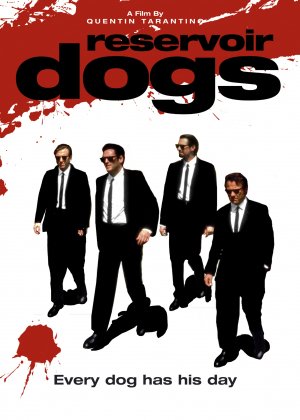
Famous for it's use of non-linear storytelling, this film is essentially the story of an armed robbery gone wrong. It opens with the main characters in a dinner just before commiting the heist, discussing Madonna's "like a virgin" over their meal. Most of the scene appears to be one continuous shot, with the camera circling the table; this is intercut with occasional closeups (Ebert, 1992). The scene ends with a slow-motion shot of them all walking in a group as the title music plays; care has been taken to ensure the rhythm of the music matches the visual rhythm of the charactors walk.
 |
| Fig. 2 Film Still |
A curious feature of the film is its timelessness; as Empire reviewer Jeff Dawson points out, "there are few contemporary reference points, the gang sports caricatured 60s Blues Brothers garb, and proceedings are underscored magnificently by a golden oldie radio station pumping out a series of bubblegum hits from the 70s." (Dawson, 1992). This timelessness paradoxically helps to keep the film feeling contemporary by forcing the audience to concentrate upon the characters rather than the scenery (although the few scenes with a mobile phone do date it). This focus on character is assisted by the absence of the actual heist; by removing the most action-packed scene the audience is more tightly focussed upon the small moments of violence as they occur throughout the film, culminating in a tense mexican standoff, compared by some critics to the climax of For A Few Dollars More and The Good, The Bad and The Ugly (McCarthy, 1992)
 |
| Fig. 3 Film Still |
List of Illustrations
Figure. 1 Dog eat Dog Productions Inc (Org) (1992) "Reservoir Dogs" Theatrical Poster [Digital Image] At: http://www.absolutegraphix.co.uk/AGimg/MoviePosterSales/l_105236_134291af.jpg (Accessed on 22/02/2011)
Figure. 2 Dog eat Dog Productions Inc (Org) (1992) Reservoir Dogs [Film Still] At: http://lastnightisaw.files.wordpress.com/2009/12/res1.jpg (Accessed on 22/02/2011)
Figure. 2 Dog eat Dog Productions Inc (Org) (1992) Reservoir Dogs [Film Still] At: http://lastnightisaw.files.wordpress.com/2009/12/res1.jpg (Accessed on 22/02/2011)
Figure. 3 Dog eat Dog Productions Inc (Org) (1992) Reservoir Dogs [Film Still] At: http://metaphilm.com/images/pheatures/reservoir-Dogs10.jpg (Accessed on 22/02/2011)
Bibliography
Canby, Vincent (1992) Reservoir Dogs (1992) In: The New York Times [Online] At: http://movies.nytimes.com/movie/review?res=9E0CE6DD113EF930A15753C1A964958260&partner=Rotten%20Tomatoes (Accessed on 22/02/2011)
Dawson, J (1992) Reservoir Dogs (18) In: empireonline.com [Online] At: http://www.empireonline.com/reviews/reviewcomplete.asp?DVDID=6455 (Accessed on 22/02/2011)
Dawson, J (1992) Reservoir Dogs (18) In: empireonline.com [Online] At: http://www.empireonline.com/reviews/reviewcomplete.asp?DVDID=6455 (Accessed on 22/02/2011)
Ebert, Roger (1992) Reservoir Dogs In: rogerebert.com [Online] At: http://rogerebert.suntimes.com/apps/pbcs.dll/article?AID=/19921026/REVIEWS/210260301 (Accessed on 22/02/2011)
McCarthy, T (1992) Reservoir Dogs In: Variety [Online] At: http://www.variety.com/review/VE1117794411?refcatid=31 (Accessed on 22/02/2011)
McCarthy, T (1992) Reservoir Dogs In: Variety [Online] At: http://www.variety.com/review/VE1117794411?refcatid=31 (Accessed on 22/02/2011)
Monday, 28 February 2011


Friday, 25 February 2011
Monday, 21 February 2011
The Birds (1963)
 |
| Fig. 1 Theatrical Poster |
Only loosely based upon the Daphne du Maurier book of the same name, this film focuses upon an impulsive and irresponsible young woman who spends a weekend in a small seaside "town" (village) only to find that the local avian population have decided to declare war on humanity,
It must be noted that the effect of the film is not down to the plot; rather the plot provides an excuse for some very effective set-pieces that have gone down in cinema history. Apparently, (at least according to Phil) most commentators interpret it as a commentary on women's empowerment and sexuality; however it seems to me that there is just as strong an argument that it is a study of the impact of outsiders on small rural communities (the distraught mother accusing Melanie Daniels (Tippi Hedren) of causing all the mayhem).
The films opening credits are filmed against a backdrop of a flock of shrieking starlings, and this introduces the recurring visual motif of the film - that of flapping, squawking menace. However, Hitchcock takes care to mislead the viewer; all of the early sights of birds are benign, everyday background scenery. The flock of seagulls circling over a city street - they must have been driven inland by a storm at sea - the caged birds in the pet shop, quietly chirping away in the background. When the first bird attack occurs - a single gull pecking at Melanie's head - the effect is shocking. The counterpoint of the bizarre - a seagull attacking a human - with the ordinary banality of the film up to that point causes the audience to question their assumptions about the film (Crowther, 1963).
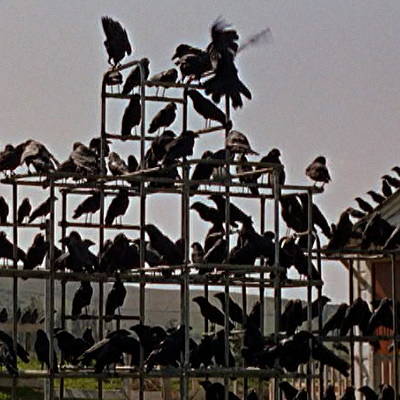
Perhaps the most famous shot of the film (certainly the most referenced) is the scene where Melanie sits on a bench outside Bodega Bay school, smoking a cigarette. Inside the school, the children are singing, and behind Melanie some crows are perched on the climbing frame. Every time the camera cuts back to Melanie smoking, the number of birds on the climbing frame increases. The tension slowly builds, as the audience waits anxiously for her to turn round and spot the avian menace behind her; at the same time the way the crows sit still and silent is highly unnatural and unnerving.
 |
| Fig. 2 Film Still [Close Up] |
The film doesn't use background music in the traditional sense; all of the soundtrack is actually happening, in the film world. There are moments of music, when Melanie plays the piano, or the radio is on, but on the whole the only sounds the audience hear are the everyday sounds of life. This ensures that whenever the birds attack, the audience's ears are assaulted by a cacophony of squawks and shrieks; the effect combining with the flapping, darting images and quick cuts onscreen to make the audience feel that they too are under attack (Time, 1963).
 |
| Fig. 3 Film Still |
There are other memorable images in the film: an overhead shot of the village, its gas station burning in the wake of an avian attack, seagulls circling in the foreground (fig. 3); Mitch Brenner (Rod Taylor) opening the door of his house after a night of being under siege to discover birds covering the ground, the roof and the trees outside; the elderly farmer lying dead in his bedroom, the first victim of the birds, covered in scratches and with his eyes apparently pecked out (fig. 4)
 |
| Fig. 4 Film Still [Close Up] |
Perhaps the most memorable feature of the film is the ending, which still feels modern despite it's age. As the small group of characters the film has focussed on get into their car and try to drive to safety, surrounded by flocks of watching birds, the film fades to black without the traditional "The End", suggesting that while this is the end of the film, it is in no way the end of the avian threat (Film 4, 2011). The audience is left to wonder what happens to Melanie and the Brenners - do they make it to safety; is there even any safety to reach?
Figure 1. Universal Pictures (Org) (1963) "The Birds" Theatrical Poster [Digital Image] At: http://www.trespassmag.com/wp-content/uploads/2010/03/the_birds_movie_poster_alfred_hitchcock.jpg (Accessed on 11/02/2011)
Figure 2. Universal Pictures (Org) (1963) The Birds [Film Still] At: http://iamyouasheisme.files.wordpress.com/2010/03/birds.jpg (Accessed on 16/02/2011)
Figure 3. Universal Pictures (Org) (1963) The Birds [Film Still] At: http://thisdistractedglobe.com/2007/10/30/the-birds-1963/ (Accessed on 21/02/2011)
Figure 4. Universal Pictures (Org) (1963) The Birds [Film Still] At: http://klausming.files.wordpress.com/2010/08/the-birds.png (Accessed on 21/02/2011)
Figure 2. Universal Pictures (Org) (1963) The Birds [Film Still] At: http://iamyouasheisme.files.wordpress.com/2010/03/birds.jpg (Accessed on 16/02/2011)
Figure 3. Universal Pictures (Org) (1963) The Birds [Film Still] At: http://thisdistractedglobe.com/2007/10/30/the-birds-1963/ (Accessed on 21/02/2011)
Figure 4. Universal Pictures (Org) (1963) The Birds [Film Still] At: http://klausming.files.wordpress.com/2010/08/the-birds.png (Accessed on 21/02/2011)
Bibliography
Crowther, Bosley (1963) "The Birds": Hitchcock's Feathered Fiends are Chilling In: The New York Times [Online] At: http://www.nytimes.com/library/film/040163hitch-birds-review.html(Accessed on 15/02/2011)
"Film4" Staff (2011) The Birds (1963) In: film4.com [Online] At: http://www.film4.com/reviews/1963/the-birds (accessed on 21/02/2011)
"Time" Staff (1963) Cinema: They Is Here In: Time Magazine [Online] At: http://www.time.com/time/magazine/article/0,9171,830097,00.html (Accessed on 20/02/2011)
"Film4" Staff (2011) The Birds (1963) In: film4.com [Online] At: http://www.film4.com/reviews/1963/the-birds (accessed on 21/02/2011)
"Time" Staff (1963) Cinema: They Is Here In: Time Magazine [Online] At: http://www.time.com/time/magazine/article/0,9171,830097,00.html (Accessed on 20/02/2011)
Friday, 18 February 2011
Terrible Beauty
Having just watched Dr Strangelove for my essay, I was reminded of a series of photographs of a world-changing moment...
Whilst it may seem macabre, I can't help feeling there is something beautiful in these images of pure physics in motion


Whilst it may seem macabre, I can't help feeling there is something beautiful in these images of pure physics in motion


Panning Shot
Again, put together with premier pro
Anyone reminded of the saying about life being like a bird flying through a room?
Monday, 14 February 2011
Essay Introduction
Here is the introduction as it stands at the moment
This essay is an investigation of the relationship between story and structure in film, specifically Dr Strangelove, directed by Stanley Kubrick. It focuses upon the stylistic, directorial and editorial choices in the film, as well as the use of filmic devices such as montage and musical themes. Key sources include Luis Mainar’s “Narrative and Stylistic Patterns in the Films of Stanley Kubrick”, which deals with the style and narrative of the films of Stanley Kubrick, and James Naremore’s “Stanley Kubrick and the Aesthetics of the Grotesque”, which looks at the juxtaposition of ridiculous and unsettling elements to create unresolved tension in the audience. The assignment will start by analysing the narrative structure of the film, in particular the use of a limited number of settings and characters, before moving upon to the design and photography of these scenes. Finally, it will examine the context and underlying themes of the film.
Story Premise
After looking at my story, I think the premise is:
"It's never too late to fulfil your childhood dreams"
"It's never too late to fulfil your childhood dreams"
Subscribe to:
Comments (Atom)