
Showing posts with label Animation Project. Show all posts
Showing posts with label Animation Project. Show all posts
Friday, 27 May 2011

Monday, 11 April 2011
Sunday, 10 April 2011
Bill Plympton (1946 - )
Bill Plympton wanted to become an animator, but when he graduated from college, animation was experiencing a downturn, with studio's closing down. As a result, he became a cartoonist, charicature artist and illustrator (Plympton, 2010) which led to him developing a highly distinctive style, which he has carried through to his animations.
His first film, Your Face, was made by Plympton alone, without the support of a studio (indeed, he states that many people told him there was no market for animations) and was a critical success, even being nominated for an Oscar. From this success, Plympton went on to create several feature films (including The Tune and I Married a strange person) as well as producing short animations for television and music videos (Weird Al Yankovich's Don't Download this Song amongst others).
Plympton's animations are characterised by his exaggerated drawing style (reminiscent of charicatures) and pencil/charcoal shading and colour; this is partly due to the fact that he produces all of the drawings himself rather than just producing keyframes. His work also makes use of extreme deformation to provide a "cartoonish" feel; this is complemented by a sense of humour reminiscent of Warner Bros. Looney Tunes cartoons, in particular Wile E. Coyote, albiet sometimes more adult.
Figure 1. October Films (1992) The Tune [Film Still] [Online] At: http://www.mundoimg.com/imagenes/peliculas/149952_mundoimg_bscap0006.jpg (Accessed on 08/04/2011)
Figure 2. MTV Networks (1991) Plymptoons [Film Still] [Online] At: http://www.fpsmagazine.com/gfx/review/060619plymptoons.jpg (Accessed on 08/04/2011)
O'Connor, R (2011) Independently Animated: Bill Plympton In: The Comics Journal [Online] At: http://www.tcj.com/reviews/independently-animated-bill-plympton/ (Accessed on 08/04/2011)
Plympton, B (2010) Animator Bill Plympton: To make a film, you must have the niavete and curiosity of a child In: indieWIRE [Online] At: http://www.indiewire.com/article/animator_bill_plympton_to_make_a_film_you_must_have_the_naivete_and_curiosi/ (accessed on 08/04/2011)
Plympton, B (2003) Bill Plympton: Biography In: Bill Plympton Studio [Online] At: http://www.plymptoons.com/biography/bio.html (Accessed on 08/04/2011)
 |
| Fig. 1 The Tune [Film Still] |
His first film, Your Face, was made by Plympton alone, without the support of a studio (indeed, he states that many people told him there was no market for animations) and was a critical success, even being nominated for an Oscar. From this success, Plympton went on to create several feature films (including The Tune and I Married a strange person) as well as producing short animations for television and music videos (Weird Al Yankovich's Don't Download this Song amongst others).
Plympton's animations are characterised by his exaggerated drawing style (reminiscent of charicatures) and pencil/charcoal shading and colour; this is partly due to the fact that he produces all of the drawings himself rather than just producing keyframes. His work also makes use of extreme deformation to provide a "cartoonish" feel; this is complemented by a sense of humour reminiscent of Warner Bros. Looney Tunes cartoons, in particular Wile E. Coyote, albiet sometimes more adult.
 |
| Fig. 2 Plymptoons [Film Still] |
List of Illustrations
Figure 1. October Films (1992) The Tune [Film Still] [Online] At: http://www.mundoimg.com/imagenes/peliculas/149952_mundoimg_bscap0006.jpg (Accessed on 08/04/2011)
Figure 2. MTV Networks (1991) Plymptoons [Film Still] [Online] At: http://www.fpsmagazine.com/gfx/review/060619plymptoons.jpg (Accessed on 08/04/2011)
Bibliography
O'Connor, R (2011) Independently Animated: Bill Plympton In: The Comics Journal [Online] At: http://www.tcj.com/reviews/independently-animated-bill-plympton/ (Accessed on 08/04/2011)
Plympton, B (2010) Animator Bill Plympton: To make a film, you must have the niavete and curiosity of a child In: indieWIRE [Online] At: http://www.indiewire.com/article/animator_bill_plympton_to_make_a_film_you_must_have_the_naivete_and_curiosi/ (accessed on 08/04/2011)
Plympton, B (2003) Bill Plympton: Biography In: Bill Plympton Studio [Online] At: http://www.plymptoons.com/biography/bio.html (Accessed on 08/04/2011)
Jiri Barta (1948 - )
A Czech animator specialising in stop-motion animation, Jiri Barta is best known for his feature-length adaptation of The Pied Piper of Hamlein. Filmed using stop motion, the film is highly recognisable due to the fact that the sets and the characters are all carved from wood (although the rats, when they appear, are real, albeit stuffed).
Both the sets and the puppets used in the film are highly stylised, with the sets in particular full of distorted perspective in a manner similar to expressionist art and film (in particular, The Cabinet of Dr Caligari). At the same time, the uneven lines and strangely flattened perspective are reminiscent of medieval woodcuts. The film combines 3D and 2D stop motion, with the 2D work resembling medieval woodcuts even more closely.
One of the most unusual features of the film is the juxtaposition of visual styles; for example while the townsfolk are carved from dark wood, with angular, exaggerated features reminiscent of cubist artworks, when the town elders sit down to feast on a banquette, they dine (messily) upon realistic food. This is echoed in the realistic rats, which scurry through the distorted landscape emphasising the unreality of it.
The film has no real dialogue (the townspeople "speak" in a high pitched squeeking strongly reminiscent of rats), with the story told through expressive body language and editing.
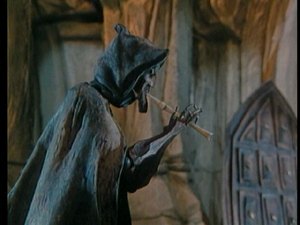 |
| Fig. 1 The Pied Piper of Hamlein [Film Still] |
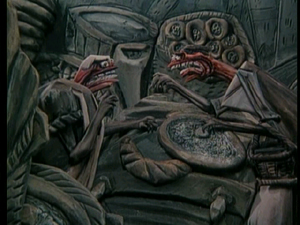 |
| Fig. 2 The Pied Piper of Hamlein [Film Still] |
The film has no real dialogue (the townspeople "speak" in a high pitched squeeking strongly reminiscent of rats), with the story told through expressive body language and editing.
List of Illustrations
Figure 1. Kratky Film Praha (1986) The Pied Piper of Hamlein [Film Still] [Online] At: http://www.dvdtalk.com/reviews/images/reviews/177/1158723060.jpg (Accessed on 09/04/2011)
Figure 2. Kratky Film Praha (1986) The Pied Piper of Hamlein [Film Still] [Online] At: http://www.dvdtalk.com/reviews/images/reviews/177/1158722964.jpg (Accessed on 09/04/2011)
Bibliography
Bio Illusion (2011) Jari Barta [Online] At: http://www.bioillusion.com/en/feature-films/in-the-attic/jiri-barta/jiri-barta.aspx (Accessed on 09/04/2011)
Kosulicova, I (2001) The Morality of Horror In: Kinoeye [Online] At: http://www.kinoeye.org/02/01/kosulicova01_no2.php (Accessed on 09/04/2011)
Rich, J (2006) Jiri Barta: Labyrinth of Darkness In: DVDTalk [Online] At: http://www.dvdtalk.com/reviews/23937/jiri-barta-labyrinth-of-darkness/ (Accessed on 09/04/2011)
Saturday, 9 April 2011
The Brothers Quay (1947 - )
Famous for their dark and surreal stop-motion animations, the Brothers Quay are identical twins from Pensylvania who studied illustration before moving on to film-making. Their style is influenced by Eastern European animators, in particular the Czech surrealist and animator Jan Svankmajer (indeed, one of their films is a direct homage to him - The Cabinet of Jan Svankmajer), but is also distinctively theirs. Filmed on miniature sets, their films are none the less full of detail, with great attention payed to colour and texture. (Zeitgeist Films, 2011).
The most famous of their films is The Street of Crocodiles, which revolves around a mysterious miniature world (the eponymous street) housed in an antique kinetoscope in an old museum somewhere in Eastern Europe. After a live-action opening, which shows the activation of the world by an offering of saliva from the museum caretaker, the film switches to the dusty, ramshakle world inside the machine. This world is populated by a variety of strange, psuedomechanical beings (many taking the form of porcelain-faced dolls) their that go about their "life" oblivious to their surroundings. Within this ghetto, a lanky, almost spider-like, "man" wanders, exploring his environment; the camera that follows his actions moving almost like another character itself (leading some to describe the camera as "the third puppet" (Rose, 2010)).
A recurring feature of the Brothers Quay's work is the extremely limited dialogue; what little information they specifically convey to the audience they impart via written captions within the film world. The films do not have explicit storylines, rather they use mise-en-scene and cryptic clues to raise questions in the mind of the audience, which they do little to answer. As a result, their films are full of ambiguous yet beautiful imagery (for example, in The Street of Crocodiles, there is a scene in which a "flock" of screws work their way free of the floorboards, dance around the main character, and then sink back into the floor).
The most famous of their films is The Street of Crocodiles, which revolves around a mysterious miniature world (the eponymous street) housed in an antique kinetoscope in an old museum somewhere in Eastern Europe. After a live-action opening, which shows the activation of the world by an offering of saliva from the museum caretaker, the film switches to the dusty, ramshakle world inside the machine. This world is populated by a variety of strange, psuedomechanical beings (many taking the form of porcelain-faced dolls) their that go about their "life" oblivious to their surroundings. Within this ghetto, a lanky, almost spider-like, "man" wanders, exploring his environment; the camera that follows his actions moving almost like another character itself (leading some to describe the camera as "the third puppet" (Rose, 2010)).
 |
| Fig. 1 The Street of Crocodiles [Film Still] |
List of Illustrations
Figure 1. Atelier Konick (1987) The Street of Crocodiles [Film Still] [Online] At: https://blogger.googleusercontent.com/img/b/R29vZ2xl/AVvXsEja1u9N5ThwoypCbvlaOdlUYZvGeupC5TBztZCpmrVMTvE1ghFCkoEQQ4rUgc47Py5rvyc00yjYEmysFkrAPrDyH5BFHuex6tJivVSuDkgjlGj33kWRwC1N62cpABSbfjKboKit3o861JQF/s1600/quay.jpg (Accessed on 08/04/2011)
Bibliography
Fitzpatrick, T (1997) The Brothers Quay [Online] At: http://www.awn.com/heaven_and_hell/QUAY/quay1.htm (Accessed on 08/04/2011)
Mazierska, E (2011) Quay, Brothers (1947 - ) In: BFI Screenonline [Online] At: http://www.screenonline.org.uk/people/id/498256/ (Accessed on 08/04/2011)
Rose, J (2010) Stephen and Timothy Quay In: Senses of Cinema [Online] At: http://www.sensesofcinema.com/2004/great-directors/quay_brothers/ (Accessed on 08/04/2011)
Zeitgeist Films Staff (2011) The Short Films of the Quay Brothers In: Zeitgeist Films [Online] At: http://www.zeitgeistfilms.com/film.php?directoryname=quayretrospective&mode=filmmaker (Accessed on 08/04/2011)
Thursday, 7 April 2011
Animation Shots
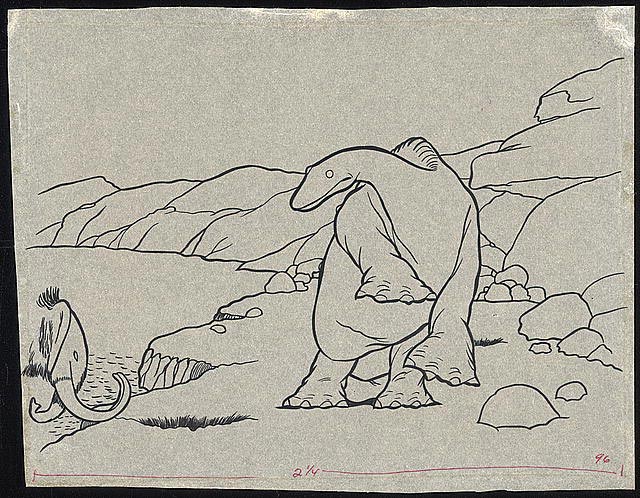
Since I'm doing boil backgrounds (like Winsor McCay's Gertie the Dinosaur), I did these guides to ensure that objects don't change size or shape too much. Black lines are for objects that don't move, coloured lines for those that do.


Ladislaw Starewicz (1882 - 1965)
Widely regarded as one of the pioneers of stop-motion animation, Ladislaw Starewicz started his career by accident. As a keen entymologist, Starewicz was attempting to film insects; however he could not pursuade the insects to do what he wanted under the powerful lamps needed for filming at the time. After several insects died from the heat, he resorted to using their corpses as puppets, attaching their legs with sealing wax to enable him to carefully reposition them between each exposure. Although the process was time consuming, it enabled Starewicz to produce the film that he wanted. So convincing was Starewicz's animation that, following the release of The Beautiful Leukanida, london newspapers wrote that the insects in the film were alive, and had been trained by an unnamed russian scientist (Bendazzi, 1994:36)
Although he was not the first person to use stop-motion animation, or puppet-based animation, Starewicz stands out as a result of his highly expressive style, which demonstrated that it was possible for animated puppets to convey emotions (and consequently, tell stories in an engaging way).
Following his inital successes, Starewicz continued to push the boundaries of what was possible with stop-motion animation; starting with manufactured puppets (instead of dead insects), then very quickly progressing onto experiments in combining live actors with stop motion (using techniques such as back projection). His work is notable for the high levels of detail they involve, with scenes often involving the animation of multiple puppets, as well as scenic elements (for example, leaves blowing in the wind), and from a technical standpoint are highly polished, with (for example) very few visible strings or other technical errors.
His most well known work is probably The Mascot (1933), a story about a toy dog which comes to life and tries to obtain an orange for its owner (some critics have drawn parallels between it and Pixar's Toy Story (1995) (Schneider, 2000)). Along the way, the dog enters a bizarre nightmare realm where rubbish comes to life and parties in a seedy club (run by the devil, formed from spilt alcohol); this scene is probably the most impressive, with a large number of characters that demonstrate a highly imaginative approach to anthropomorphisation (as well as a convincingly animated band)
The film also features several technically impressive sequences; the mascot hanging from the rear window of a car as it drives along (swinging realistically with the back-projected footage), and two animated skeletons (including a fish skeleton that swims in midair). However, the most impressive aspect of the film is the expressive animation that enables the audience to identify with the characters.
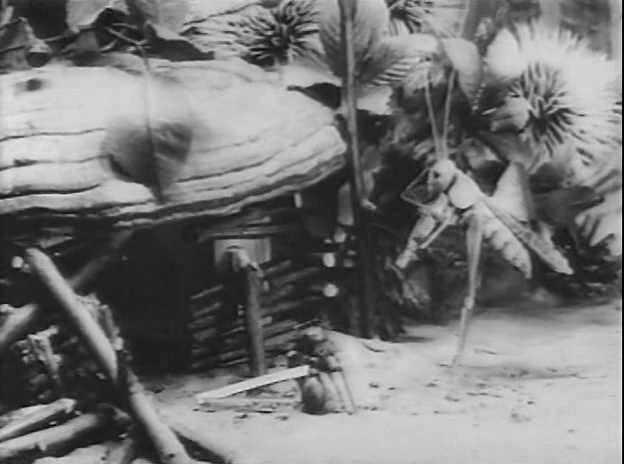 |
| Fig. 1 The Grasshopper and the Ant [Film Still] |
Following his inital successes, Starewicz continued to push the boundaries of what was possible with stop-motion animation; starting with manufactured puppets (instead of dead insects), then very quickly progressing onto experiments in combining live actors with stop motion (using techniques such as back projection). His work is notable for the high levels of detail they involve, with scenes often involving the animation of multiple puppets, as well as scenic elements (for example, leaves blowing in the wind), and from a technical standpoint are highly polished, with (for example) very few visible strings or other technical errors.
His most well known work is probably The Mascot (1933), a story about a toy dog which comes to life and tries to obtain an orange for its owner (some critics have drawn parallels between it and Pixar's Toy Story (1995) (Schneider, 2000)). Along the way, the dog enters a bizarre nightmare realm where rubbish comes to life and parties in a seedy club (run by the devil, formed from spilt alcohol); this scene is probably the most impressive, with a large number of characters that demonstrate a highly imaginative approach to anthropomorphisation (as well as a convincingly animated band)
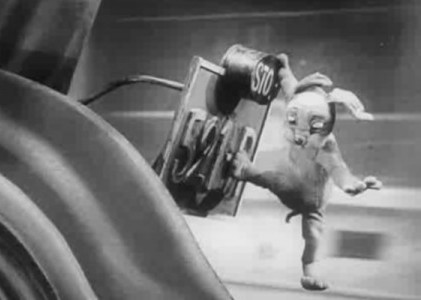 |
| Fig. 2 The Mascot [Film Still] |
List of Illustrations
Figure 1. Kanzkhonkov (1911) The Grasshopper and the Ant [Film Still] Online At: http://lh3.google.com/agustin.gomila/RwTdaECWSrI/AAAAAAAABrA/wunzs8h0QIY/s800/Captura2.png (Accessed on 05/04/2011)
Figure 2. Gelma Films (!934) The Mascot [Film Still] Online At: http://www.movingimagesource.us/images/articles/Mascota01_2-20090717-120839-medium.jpg (Accessed on 05/04/2011)
Bibliography
Bendazzi, G (1994) Cartoons: One Hundred years of animation, Indiana University Press (USA)
Brooke, M (2011) Ladislaw Starewicz In: IMDB.com [Online] At: http://www.imdb.com/name/nm0823088/bio (Accessed on 05/04/2011)
Potamkin, H (1929) Ladislaw Starevich and His Doll Films In: Theater Guild Magazine [Online] At: http://www.awn.com/heaven_and_hell/STARE/stare7.htm (Accessed on 05/04/2011)
Schneider, E (2000) Entomology and Animation: A Portrait of An Early Master Ladislaw Starewicz In: Animation World Magazine Issue 5 [Online] At: http://www.awn.com/mag/issue5.02/5.02pages/schneiderstarewicz6.php3 (Accessed on 05/04/2011)
Seeton, M (1936) The Modern Aesop In: World Film News [Online] At: http://ls.pagesperso-orange.fr/tmseton.htm (Accessed on 05/04/2011)
Wednesday, 6 April 2011
Walt Disney (1901 - 1966)
A name that has become synonymous with animation, Walt Disney started his career creating "Alice Comedies", short films that combined live action and animation. Whilst the early works were popular, declining audiences led Disney to develop his first comercially successful animated character, Oswald the Rabbit. A lawsuit by Disney's distributor led to him loosing the rights to Oswald, forcing him to develop a new character, Mickey Mouse (As a result of this, Disney ensured that he kept the rights to all of his subsequent characters) (findagrave.com, 2011).
The dispute with his distributor had resulted with Disney losing all of his animators except his friend Ub Iwerks, forcing him to produce his next animation on a shoestring budget (according to some sources, Disney's wife was drafted in to ink the animation cels (Peter, 1990)). The first two Mickey Mouse films were not commercial successes; however, following the debut of The Jazz Singer, the first film to succesfully synchronise film and sound, Disney used the technology to add sound to the third film, Steamboat Willie. As well as being the first animated film to feature synchronised sound, Steamboat Willie was a massive comercial success.
Disney continued to push the developement of animation; he created the first animation in colour (Flowers and Trees (1932), which was also the first animation to win an oscar), the multiplane camera (which enabled the use of up to 7 different layers in the creation of animations), the first talking animated character (Mickey Mouse, voiced by Disney himself whilst he was alive) and finally, the first feature length animated film (Snow White and the Seven Dwarfs (1937)).
The animation studio founded by Disney is credited with being one of the most important institutions in the history of animation; as well as pioneering animation technologies, it was responsible for formalising "the 12 rules of animation" that are used by animators to this day.
List of Illustrations
 |
| Fig. 1 Oswald the Lucky Rabbit |
 |
| Fig. 2 Steamboat Willie [Film Still] |
 |
| Fig. 3 Snow White and the Seven Dwarfs |
List of Illustrations
Figure 1. Universal Pictures (c1927) Oswald the Lucky Rabbit [Digital Image] At: http://lantz.goldenagecartoons.com/profiles/oswald/disneyoswald.jpg (Accessed on 05/04/2011)
Figure 2. Walt Disney Productions (1928) Steamboat Willie [Film Still] Online At: http://www.cartoonreviewsite.com/series/mm/sw5.jpg (Accessed on 05/04/2011)
Figure 3. Walt Disney Productions (1937) Snow White and the Seven Dwarfs [Digital Image] At: http://3.bp.blogspot.com/_Zj2KakUZYyE/TREwS7w8dWI/AAAAAAAAC9w/4epeVLJ4MFk/s1600/snow-white-seven-dwarfs8.jpg (Accessed on 05/04/2011)
Figure 3. Walt Disney Productions (1937) Snow White and the Seven Dwarfs [Digital Image] At: http://3.bp.blogspot.com/_Zj2KakUZYyE/TREwS7w8dWI/AAAAAAAAC9w/4epeVLJ4MFk/s1600/snow-white-seven-dwarfs8.jpg (Accessed on 05/04/2011)
Bibliography
findagrave.com (2011) Walt Disney (1901 - 1966) [Online] At: http://www.findagrave.com/cgi-bin/fg.cgi?page=gr&GRid=284 (Accessed on 05/04/2011)
Peter, T (1990) Walt Disney - Biography In: IMDB.com [Online] At: http://www.imdb.com/name/nm0000370/bio (Accessed on 05/04/2011)
TCM Staff (2011) Walt Disney: Biography In: tcm.com [Online] At: http://www.tcm.com/tcmdb/person/50875|153163/Walt-Disney/ (Accessed on 05/04/2011)
TCM Staff (2011) Walt Disney: Biography In: tcm.com [Online] At: http://www.tcm.com/tcmdb/person/50875|153163/Walt-Disney/ (Accessed on 05/04/2011)
Monday, 4 April 2011
Norman McLaren (1914 - 1987)
Born in Scotland, Norman Mclaren studied set design at the Glasgow School of fine art; however, it was his membership of the Glasgow Film Society that started his interest in cinema and the possibilites of moving pictures. After graduating, he became a cameraman, initially working for the GPO film unit, then the National Film Board of Canada (making propaganda films during WWII). During his free time, he experimented with novel filmic techniques, such as drawing or directly onto the film stock or stop-motion animation.
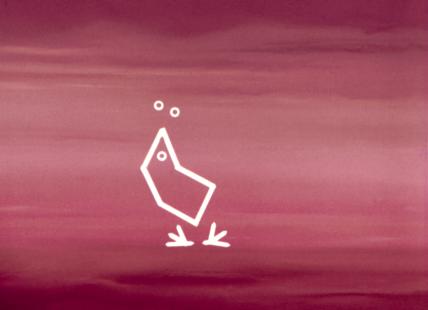
His earliest experiments consisted of scratching the emulsion from the film to create white lines on a black background (according to some accounts, he was forced into this by the fact that he had no access to a camera (Konczewski, 1990)). Further development of the technique led to several abstract films, such as Begone Dull Care, in which abstract strokes of colour dance and morph in time to the backing music; this was produced by painting directly upon a frameless film strip.
A common theme in McLaren's short films is the importance of music, particularly in his more abstract films where the soundtrack unites sometimes dispirate imagery into a cohesive whole. Several other films are based around the soundtrack, for example Le Merle - a visual representation of a childrens nursery rhyme about a crow created using paper shapes animated on a coloured background.
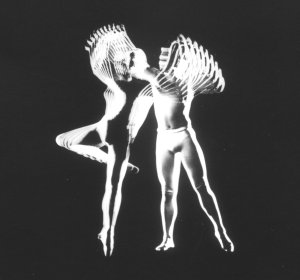
McLaren continued to experiment with new techniques, including pioneering work with optical printers and 3D films. One of his most visually interesting works is Pas de Deux, which consists of two ballet dancers dancing against a black background. The unique feature is a sort of "motion trail" effect, where multiple images are superimposed in a single frame, leading to a heightened sense of motion and a distorted sense of time.
Jean, M (2006) Norman McLaren - The Tireless Innovator In: National Film Board of Canada [Online] At: http://www3.nfb.ca/animation/objanim/en/filmmakers/Norman-McLaren/overview.php (Accessed on 04/04/2011)
Konczewski, M (1990) Norman McLaren In: IMDB.com [Online] At: http://www.imdb.com/name/nm0572235/bio (Accessed on 04/04/2011)
National Film Board of Canada (2010) NFB Profiles: McLaren, Norman In: National Film Board of Canada [Online] At: http://www.nfb-onf.gc.ca/eng/portraits/norman_mclaren/ (Accessed on 04/04/2011)
His earliest experiments consisted of scratching the emulsion from the film to create white lines on a black background (according to some accounts, he was forced into this by the fact that he had no access to a camera (Konczewski, 1990)). Further development of the technique led to several abstract films, such as Begone Dull Care, in which abstract strokes of colour dance and morph in time to the backing music; this was produced by painting directly upon a frameless film strip.
 |
| Fig. 1 Begone Dull Care [Film Still] |
 |
| Fig. 2 Le Merle [Film Still] |
 |
| Fig. 3 Pas de Deux [Film Still] |
List of Illustrations
Figure 1. National Film Board of Canada (1949) Begone Dull Care [Film Still] At: http://www.moviemail-online.co.uk/images/large/19025_Norman-mclaren-1.JPG (Accessed on 04/04/2011)
Figure 2. National Film Board of Canada (1959) Le Merle [Film Still] At: http://www3.nfb.ca/web428x321/Films/11122/11122_4.jpg (Accessed on 04/04/2011)
Figure 3. National Film Board of Canada (1968) Pas de Deux [Film Still] At: http://www.tbray.org/ongoing/When/200x/2003/09/03/PDD.png (Accessed on 04/04/2011)
Figure 2. National Film Board of Canada (1959) Le Merle [Film Still] At: http://www3.nfb.ca/web428x321/Films/11122/11122_4.jpg (Accessed on 04/04/2011)
Figure 3. National Film Board of Canada (1968) Pas de Deux [Film Still] At: http://www.tbray.org/ongoing/When/200x/2003/09/03/PDD.png (Accessed on 04/04/2011)
Bibliography
Jean, M (2006) Norman McLaren - The Tireless Innovator In: National Film Board of Canada [Online] At: http://www3.nfb.ca/animation/objanim/en/filmmakers/Norman-McLaren/overview.php (Accessed on 04/04/2011)
Konczewski, M (1990) Norman McLaren In: IMDB.com [Online] At: http://www.imdb.com/name/nm0572235/bio (Accessed on 04/04/2011)
National Film Board of Canada (2010) NFB Profiles: McLaren, Norman In: National Film Board of Canada [Online] At: http://www.nfb-onf.gc.ca/eng/portraits/norman_mclaren/ (Accessed on 04/04/2011)
Sexton, J (2003) McLaren, Norman (1914-1987) In: BFI Screenonline [Online] At: http://www.screenonline.org.uk/people/id/446775/ (Accessed on 04/04/2011)
Animation update
here's the first 10 seconds or so of animation, with soundtrack
and here's it slotted into the animatic (for some reason the sound doesn't work ^^;)
Monday, 28 March 2011
Friday, 25 March 2011
Thursday, 24 March 2011
Wednesday, 23 March 2011
Lotte Reiniger (1899 - 1981)
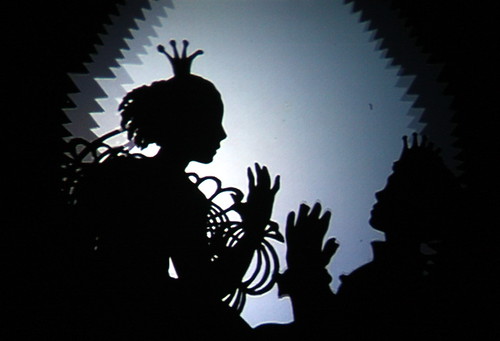
Lotte Reiniger was a german artist who produced animated stories using silhouettes cut from paper. Her work was based upon the ancient tradition of shadow-puppetry, but instead of filming a performance in real time, the shadow-puppets were photographed, moved and photographed again, in a process similar to stop-motion animation.
The physical nature of the puppets gives the animation a realistic feeling, as there are none of the "boils" and deformations that occur with drawn animation. At the same time, there is no mismatch between the characters and the background, which can occur with cel animation.
Stylistically, Reiniger's animations are highly distinctive, in part because of the rarity of silhouette animation, but also because of the careful design of her puppets. Although they are often highly intricate, the silhouette always remains clear and identifiable; a feature that helps the audience to "read" the characters.
The character design is timeless, with the personality of the character easily visible even to modern audiences; at the same time, they move with a fluidity that can still captivate the viewer.
Although time consuming, the technique of silhouette animation was considerably cheaper than cel-based animation, which enabled Reiniger to continue making films long after the accension of cel animation. However, the success of the medium is highly dependent upon the skill of the character creator and animator (Reiniger), and cannot easily be distributed in the manner of cel animation studios.
 |
| Fig. 1 Cinderella [film still] |
Stylistically, Reiniger's animations are highly distinctive, in part because of the rarity of silhouette animation, but also because of the careful design of her puppets. Although they are often highly intricate, the silhouette always remains clear and identifiable; a feature that helps the audience to "read" the characters.
 |
| Fig. 2 Cinderella [Film Still] |
The character design is timeless, with the personality of the character easily visible even to modern audiences; at the same time, they move with a fluidity that can still captivate the viewer.
Although time consuming, the technique of silhouette animation was considerably cheaper than cel-based animation, which enabled Reiniger to continue making films long after the accension of cel animation. However, the success of the medium is highly dependent upon the skill of the character creator and animator (Reiniger), and cannot easily be distributed in the manner of cel animation studios.
List of Illustrations
Figure 1. Institut für Kulturforschung (1922) Cinderella [Film Still] At:http://www.flickr.com/photos/bernimartinjersey/3978026232/ (Accessed on 23/03/2011)
Figure 2. Institut für Kulturforschung (1922) Cinderella [Film Still] At: http://wondersinthedark.wordpress.com/2010/12/21/3-cinderella/ (Accessed on 23/03/2011)
Bibliography
Dasitidar, A. G. (2011) Lotte Reiniger's Silhouettes [Online] At: http://frontierindia.scriptmania.com/page30.htm (Accessed on 23/03/2011)
Kemp, P (2003) Reiniger, Lotte (1899 - 1981) In: BFI Screenonline [Online] At: http://www.screenonline.org.uk/people/id/528134/ (Accessed on 23/03/2011)
Larson, E.H. (1999) Lotte Reiniger Information [Online] At: http://www.nwlink.com/~erick/silentera/reiniger/reiniger.html (Accessed on 23/03/2011)
Tuesday, 22 March 2011
Devious Walks

The top one really needs a long flowing robe to work, but the bottom one seems more like an Igor to me... ^^;
Winsor McCay (1869 - 1934)
Often credited as the father of modern animation (he created the first animated film comprised entirely of artwork, as well as the first character designed specifically for an animation (Cartoonist Group, 2011)), Winsor McCay started out as an illustrator, creating advertising posters. He then moved on to cartooning, creating several popular comic strips, including "Little Nemo in Slumberland". At the same time, he had a successful carrier in vaudeville, drawing amusing "lightning sketches" on stage using a blackboard and chalk. Supposedly inspired by an advertising flip-book, he produced short animations that he incorporated into his vaudeville act.
His most famous animated creation, Gertie the Dinosaur, was premiered in 1914. It involves an animated brontosaurus (Gertie) who interacted with McCay, obeying spoken instructions and finally giving him a ride. As the cel technique of animating the character separately from the background had not yet been invented, the background had to be drawn on each frame; however McCay did not do this himself but employed assistants to do it for him. As a result, the background "boils", imbuing it with a greater sense of life than if it was simply static. This also ensures that the audience cannot tell that (for example) the tree is going to move at some point, as they could with a cel animation. McCay also makes use of "loops" to extend the animation, but since these looped actions follow a constant beat, they emphasise the "rhythm" of the animation.
 |
| Fig. 1 Gertie the Dinosaur [animation frame] |
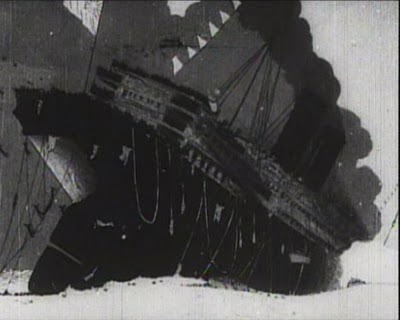 |
| Fig. 2 The Sinking of the Lusitania [Animation Frame] |
McCay's next work was a propoganda film about the sinking of the passenger liner RMS Lusitani in WWI. Made using cel animation, it is notable for its very realistic depiction of smoke and steam, as well as the general quality of the animation. Although a silent film, text boards provide the audience with information of what is happening, emphasising the pseudo-documentary nature of the piece; however the final text board is obviously propagandic in nature, and this undermines any apparant impartiality in the film.
List of Illustrations
Figure 1. Winsor McCay (1914) Gertie the Dinosaur [animation frame] [digital image] At: http://animationreview.wordpress.com/2010/06/21/gertie-the-dinosaur/ (Accessed on 21/03/2011)
Figure 2. Winsor McCay (1918) The Sinking of the Lusitania [animation frame] [digital image] At: http://animationreview.wordpress.com/2010/06/22/the-sinking-of-the-lusitania/ (Accessed on 21/03/2011)
Bibliography
Dr Grob's Animation Review (2010) Gertie the Dinosaur [Online] At: http://animationreview.wordpress.com/2010/06/21/gertie-the-dinosaur/ (Accessed on 21/03/2011)
Dr Grob's Animation Review (2010) The Sinking of the Lusitania [Online] At: http://animationreview.wordpress.com/2010/06/22/the-sinking-of-the-lusitania/ (Accessed on 21/03/2011)
Van Eaton Galleries (2011) A Brief Biography of Winsor McCay [Online] At: http://www.vegalleries.com/winsorbio.html (Accessed on 21/03/2011)
Subscribe to:
Comments (Atom)